Week 9
European and Black Immigrants in America
Soci—231
European Immigrants in the United States-
October 27th
Reminders and Updates
Response Memos
Response Memo Deadline
You do not have to submit a response memo this week.
Reminders and Updates
A Note on the Midterm
Grades will be posted on Moodle by the
end of the week.
Reminders and Updates
Instructions Are Online
Reminders and Updates
Until the 2026 U.S. Midterm Elections
Election Day — Tuesday, November 3rd
Flux and Choice in American Ethnicity
(Waters 1994)
Ethnic Options
Census and survey data on later-generation white ethnics in the 1970s and 1980s have yielded an interesting and what may appear at first to be a startling finding—ethnic identity is a social process that is in flux for some proportion of the population. Far from being an automatic labeling of a primordial characteristic, ethnic identification is, in fact, a dynamic and complex social phenomenon.
(Waters 1990:16, EMPHASIS ADDED)
Ethnic Options
Most people assume that ethnic groups are stable categories and that one is a member of a particular ethnic group because one’s ancestors were members of that group. Thus one is French because one’s ancestors were French and because the category French exists and has meaning. One may know that the Normans, the Franks, the Burgundians, and the Gauls were once separate groups who came to be known as French, but that does not necessarily make the category French any less “real” to a particular individual.
(Waters 1990:17, EMPHASIS ADDED)
Ethnic Options
How do sociologists conceptualize ethnicity?
Ethnic Options
[M]ost sociologists study ethnicity from social, situational, or rational points of view, seeking to understand the forces in society that create, shape, and sustain ethnic identity. They often defend such approaches from an opposite, biologically based understanding of ethnicity … Sociologists’ definitions of ethnicity stress that it involves the belief on the part of people that they are descended from a common ancestor and that they are part of a larger grouping.
(Waters 1990:17, EMPHASIS ADDED)
Ethnic Options
Sociologists have shifted focus to the construction, destruction and reconstruction of
ethnic boundaries.
Ethnic Options
Review From Week 7
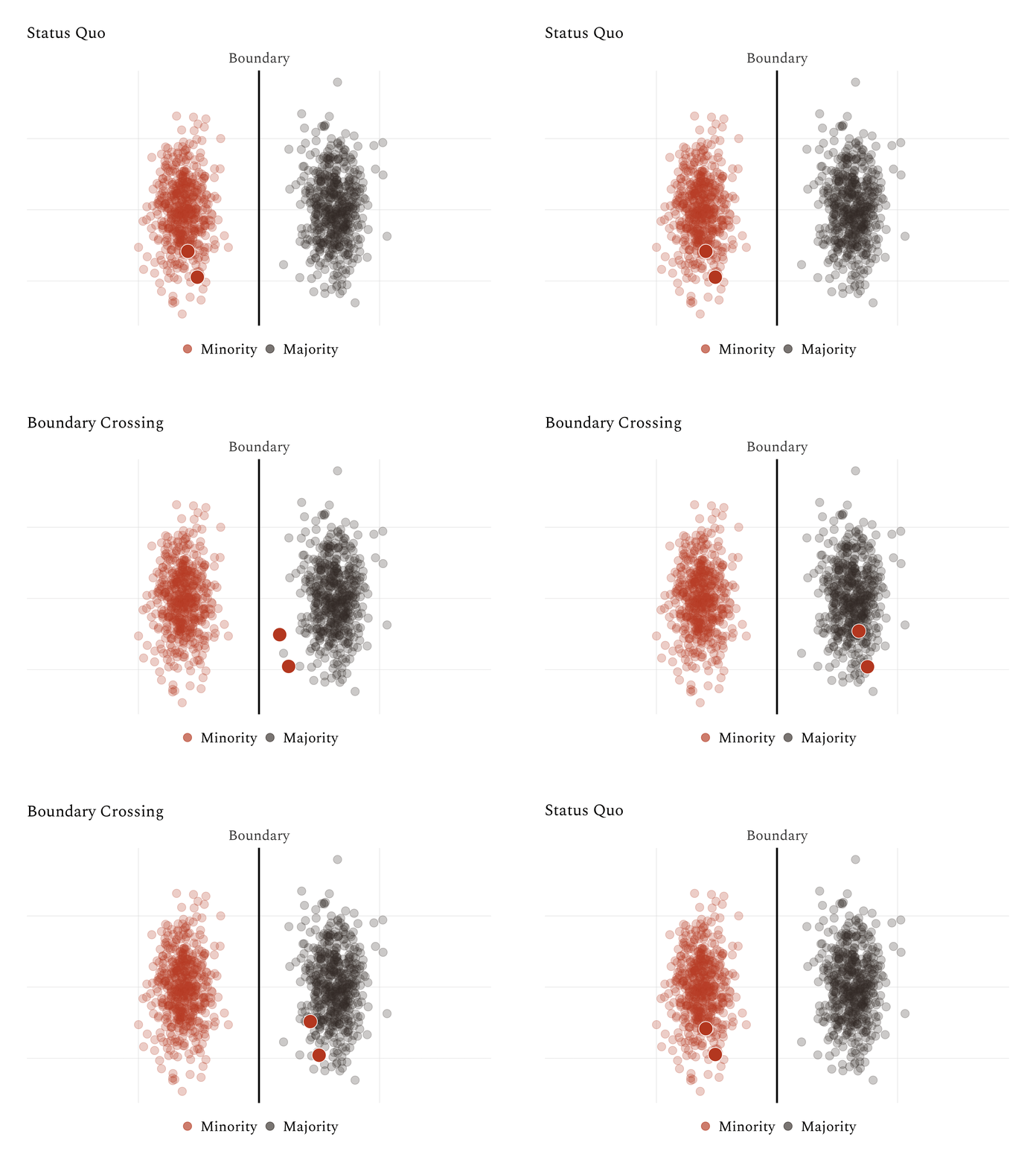
Crossing
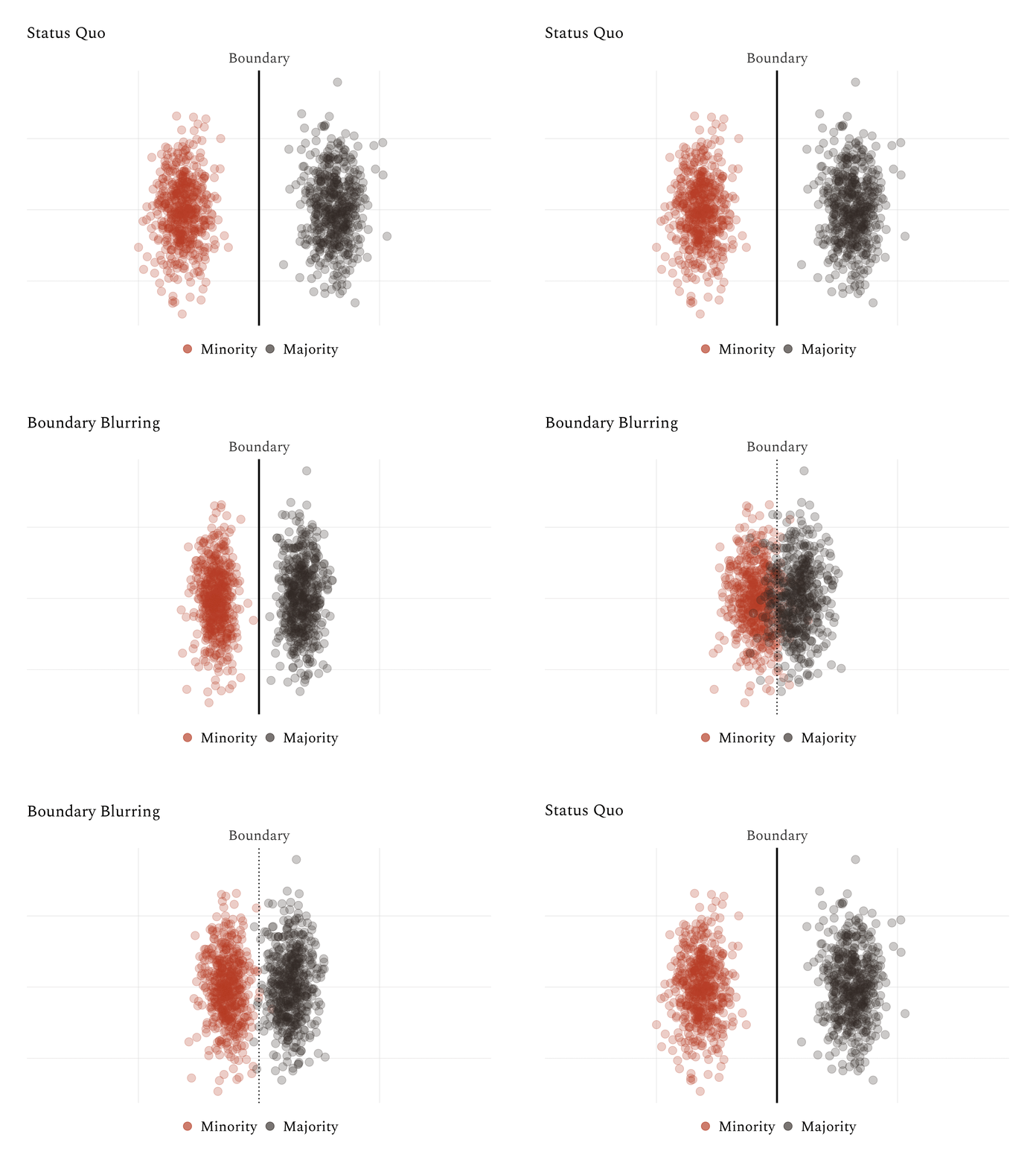
Blurring
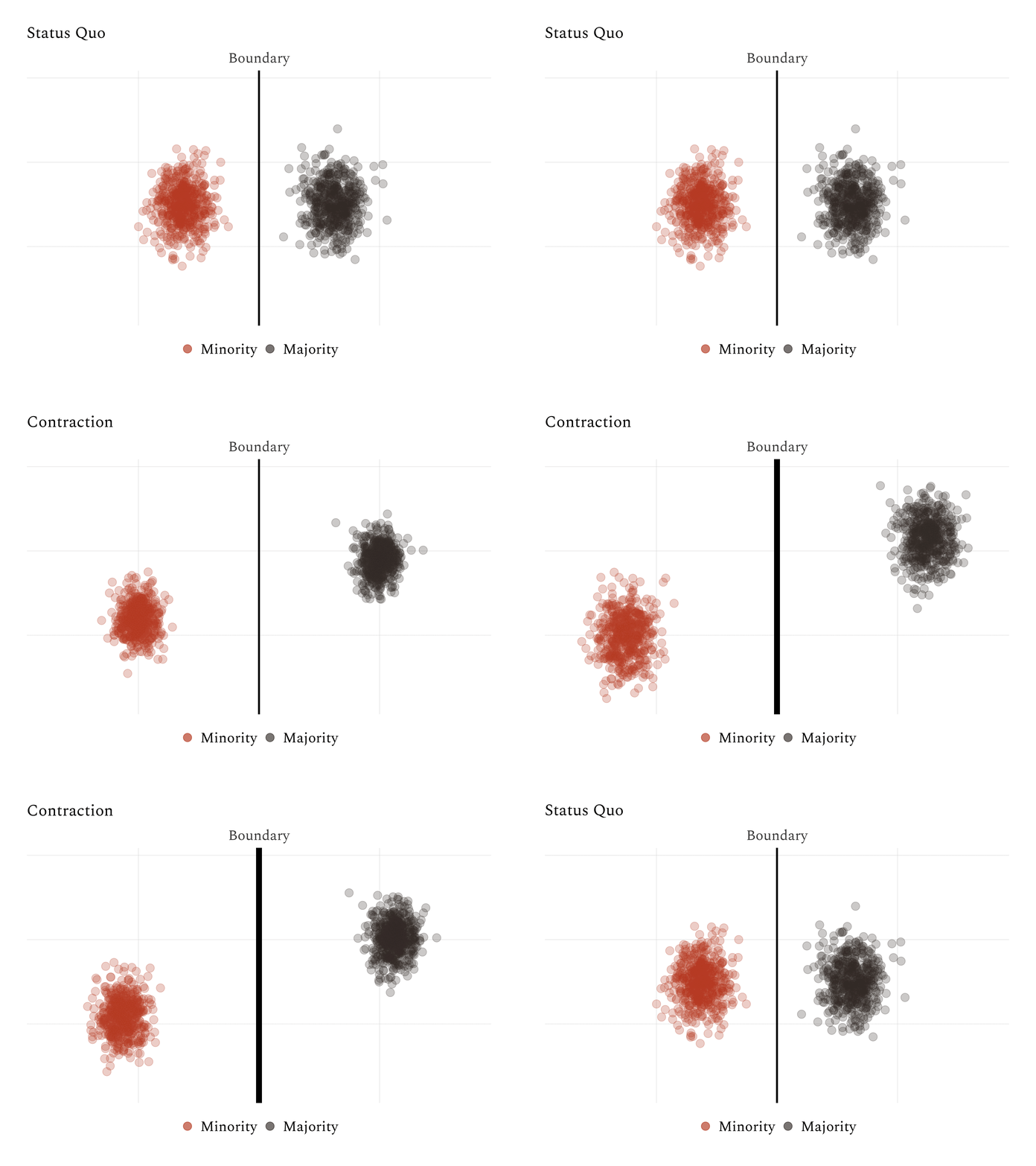
Shifting: Contraction
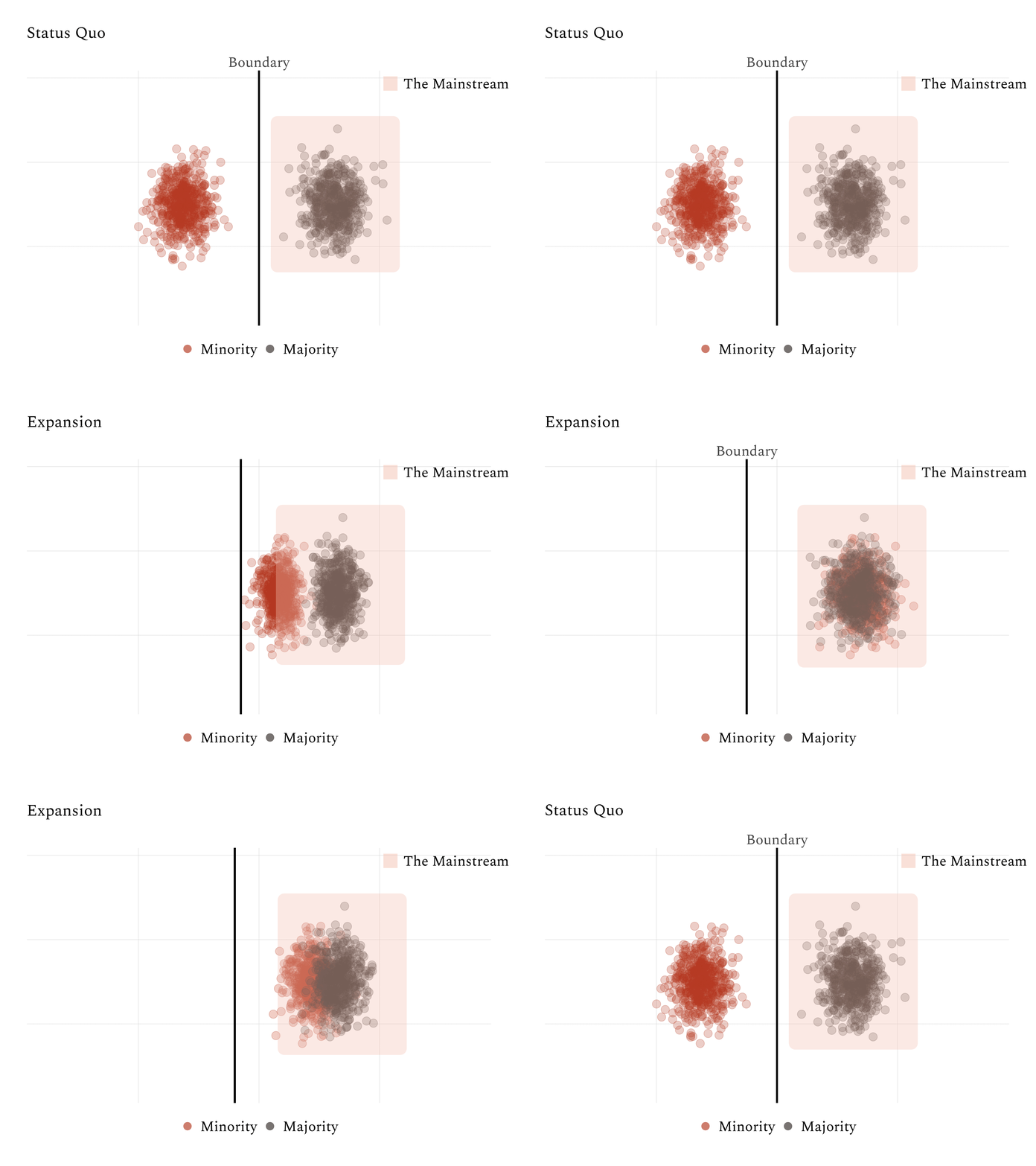
Shifting: Expansion
Ethnic Options
If boundaries are in flux, are immigrant-origin people free to choose any ethnic label or
identity they desire?
Constraints
[P]eople’s belief that racial or ethnic categories are biological, fixed attributes of individuals does have an influence on their ethnic identities. This popular understanding of ethnicity means that people behave as if it were an objective fact even when their own ethnicity is highly symbolic. This belief that ethnicity is biologically based acts as a constraint on the ethnic choices of some Americans, but there is nonetheless a range of latitude available in deciding how to identify oneself and whether to do so in ethnic terms.Whites enjoy a great deal of freedom in these choices; those defined in “racial” terms as non-whites much less.
(Waters 1990:18, EMPHASIS ADDED)
Constraints
Du Bois (1897)
W. E. B. Du Bois, “Strivings of the Negro People” The Atlantic, 1897 Open in new tab
A Contrast
Black Americans, for example, are highly socially constrained to identify as blacks, without other options available to them, even when they believe or know that their forebears included many non-blacks.
(Waters 1990:18, EMPHASIS ADDED)
Constraints and Options
For white ethnics, however, ethnic identification involves both choice and constraint. Children learn both the basic facts of their family history and origins and the cultural content and practices associated with their ethnicity in their households. This process itself often involves a sifting and simplifying of various options.
(Waters 1990:19, EMPHASIS ADDED)
Constraints and Options
The interaction between choice and constraint in ethnic identification is most obvious in the case of the children of mixed marriages. But even the relationship between believed ethnic origin and self- identification for people of single ancestry involves a series of choices. For instance, individuals who believe their ancestry to be solidly the same in both parents’ backgrounds can (and often do) choose to suppress that ancestry and self-identify as “American” or try to pass as having an ancestry they would like to have. The option of identifying as ethnic therefore exists for all white Americans, and further choice of which ethnicity to choose is available to some of them.
(Waters 1990:19, EMPHASIS ADDED)
Choosing an Ancestry
In effect, some immigrant-origin people of European origin can choose an ancestry.
Choosing an Ancestry
The ways people come to an ethnic self-identification are highlighted in cases where an individual believes that his or her parents are of different ancestries and must then make a decision about which ancestry to identify with. Sometimes this is not even a decision, but is socialized so early in life that people are not even aware of it … When faced with a heterogeneous group of ancestors, a person who is going to simplify or identify with one or the other side is slightly more likely to choose the father’s ancestry, but obviously it is not an automatic process in which all individuals choose the paternal line to determine ancestry.
(Waters 1990:21–22, EMPHASIS ADDED)
Choosing an Ancestry
Even though it was a breakthrough for the 1980 census to allow more than one ancestry … (Waters’) interviews suggest that such surveys underestimate the mixing of the population. This is because it is often assumed when analyzing these surveys that only those giving a multiple ancestry are the result of ethnic intermixing. However, people frequently make choices and sift through their ancestries before naming an ancestry. Many people who give a multiple ancestry have simplified from an even greater number of possibilities, and many people who give a single ancestry are actually aware of multiple possible ancestries in their backgrounds.
(Waters 1990:22, EMPHASIS ADDED)
Choosing an Ancestry
The ways in which people described their family histories and the ways in which they came to their answers reveal just how much sifting and sorting occurs even before they consider the question. The complex interplay among the different aspects of an individual’s ethnic identification was an overriding theme in the interviews.
(Waters 1990:23, EMPHASIS ADDED)
Symbolic Ethnicity
(Gans 1979)
Ethnicity in the Third Generation
For the third generation, the secular ethnic cultures which the immigrants brought with them are now only an ancestral memory, or an exotic tradition to be savored once in a while in a museum or at an ethnic festival. The same is true of the ‘Americanization cultures’, the immigrant experience and adjustment in America … The old ethnic cultures serve no useful function for third generation ethnics who lack direct and indirect ties to the old country, and neither need nor have much knowledge about it. Similarly, the Americanization cultures have little meaning for people who grew up without the familial conflict over European and American ways that beset their fathers and mothers: the second generation which fought with and was often ashamed of immigrant parents.
(Gans 1979:6, EMPHASIS ADDED)
Ethnicity in the Third Generation
Some sociocultural patterns marking the European third-generation (of the 1970s) included:
Movement into non-ethnic primary groups (e.g., via exogamous relationships and intermarriage).
Movement out of ethnic cliques, homophilous social networks and professional or occupational spaces.
Residence in diverse neighbourhoods contra the ethnic clustering and spatial concentration of yore.
And yet.
A New Mode of Ethnicity
[W]hile ethnic ties continue to wane for the third generation, people of this generation continue to perceive themselves as ethnics, whether they define ethnicity in sacred or secular terms. Jews continue to remain Jews because the sacred and secular elements of their culture are strongly intertwined, but the Catholic ethnics also retain their secular or national identity, even though it is separate from their religion.
(Gans 1979:7, EMPHASIS ADDED)
A New Mode of Ethnicity
My hypothesis is that in this generation, people are less and less interested in their ethnic cultures and organizations — both sacred and secular — and are instead more concerned with maintaining their ethnic identity, with the feeling of being Jewish, or Italian, or Polish, and with finding, ways of feeling and expressing that identity in suitable ways … Third generation ethnics can join an ethnic organization, or take part in formal or informal organizations composed largely of fellow-ethnics; but they can also find their identity by ‘affiliating’ with an abstract collectivity which does not exist as an interacting group. That collectivity, moreover, can be mythic or real, contemporary or historical.
(Gans 1979:7, EMPHASIS ADDED)
A New Mode of Ethnicity
In other words, as the functions of ethnic cultures and groups diminish and identity becomes the primary way of being ethnic, ethnicity takes on an expressive rather than instrumental function in people’s lives, becoming more of a leisure-time activity and losing its relevance, say, to earning a living or regulating family life.
(Gans 1979:9, EMPHASIS ADDED)
A New Mode of Ethnicity
Symbolic ethnicity can be expressed in a myriad of ways, but above all, I suspect, it is characterized by a nostalgic allegiance to the culture of the immigrant generation, or that of the old country; a love for and a pride in a tradition that can be felt without having to be incorporated in everyday behavior. The feelings can be directed at a generalized tradition, or at specific ones: a desire for the cohesive extended immigrant family, or for the obedience of children to parental authority, or the unambiguous orthodoxy of immigrant religion, or the old-fashioned despotic benevolence of the machine politician.
(Gans 1979:9, EMPHASIS ADDED)
Let’s Briefly Pause
Group Exercise
The Exercise
In small groups, go through the data presented in the next slide—all drawn from Waters (1990). Then, answer the following questions:
What do these data tell us about ethnic options and symbolic ethnicity among immigrant-origin people of European descent?
More generally, how can we apply the assimilation theories covered in Part I of this course to make sense of the data—and symbolic ethnicity in general? In furnishing an answer, think about classical, segmented, and neo-assimilation theories.
The Data
An Example: Bill Kerrigan (see Waters 1990:24)
What is your answer to the census question?
I would have put Irish.
Why would you have answered that?
Well, my dad’s name is Kerrigan and my mom’s name is O’Leary, and I do have some German in me, but if you figure it out, I am about 75 percent Irish, so I say I am Irish.
You usually don’t say German when people ask?
No, no, I never say I am German. My dad just likes being Irish… I don’t know, I guess I just never think of myself as being German.
So your dad’s father is the one who immigrated?
Yes. On this side it is Irish for generations. And then my grandmother’s name is Dubois, which is French, partly German, partly French, and then the rest of the family is all Irish. So it is only my maternal grandmother who messes up the line.
Reported
Irish about 75 percent
Set aside
German never claimed
French maternal grandmother
Adaptation of Table 5 from Waters (1990) Click a column to sort
Adaptation of Table 7 from Waters (1990) Click a column to sort
Black Immigrants in the United States-
October 29th
Reminders
Final Paper Proposal
Reminders
Final Presentations and the Term Paper
Black Immigrants and Black America
(Hamilton 2020)
A Growing Subpopulation
By 2014, approximately four million black immigrants were living in the United States. At that time, 10% of the overall immigrant population identified as black and 9.2% of the population who identified as black were immigrants … If the growth in black immigration continues, this group and their descendants will play a significant role in driving the social and economic trajectories of the US black population over the next several decades.
(Hamilton 2020:296, EMPHASIS ADDED)
A Growing Subpopulation
While Caribbean immigration dominated black immigration throughout the 1980s and the early 1990s, African immigrants drove black immigration during the late 1990s and the first two decades of the twenty-first century … By 2013, 1.3 million black African immigrants were residing in the United States. While Caribbean immigration also increased between 2000 and 2013, growing by 33%, African immigration increased by 137% during the same period.
(Hamilton 2020:296, EMPHASIS ADDED)
A Growing Subpopulation
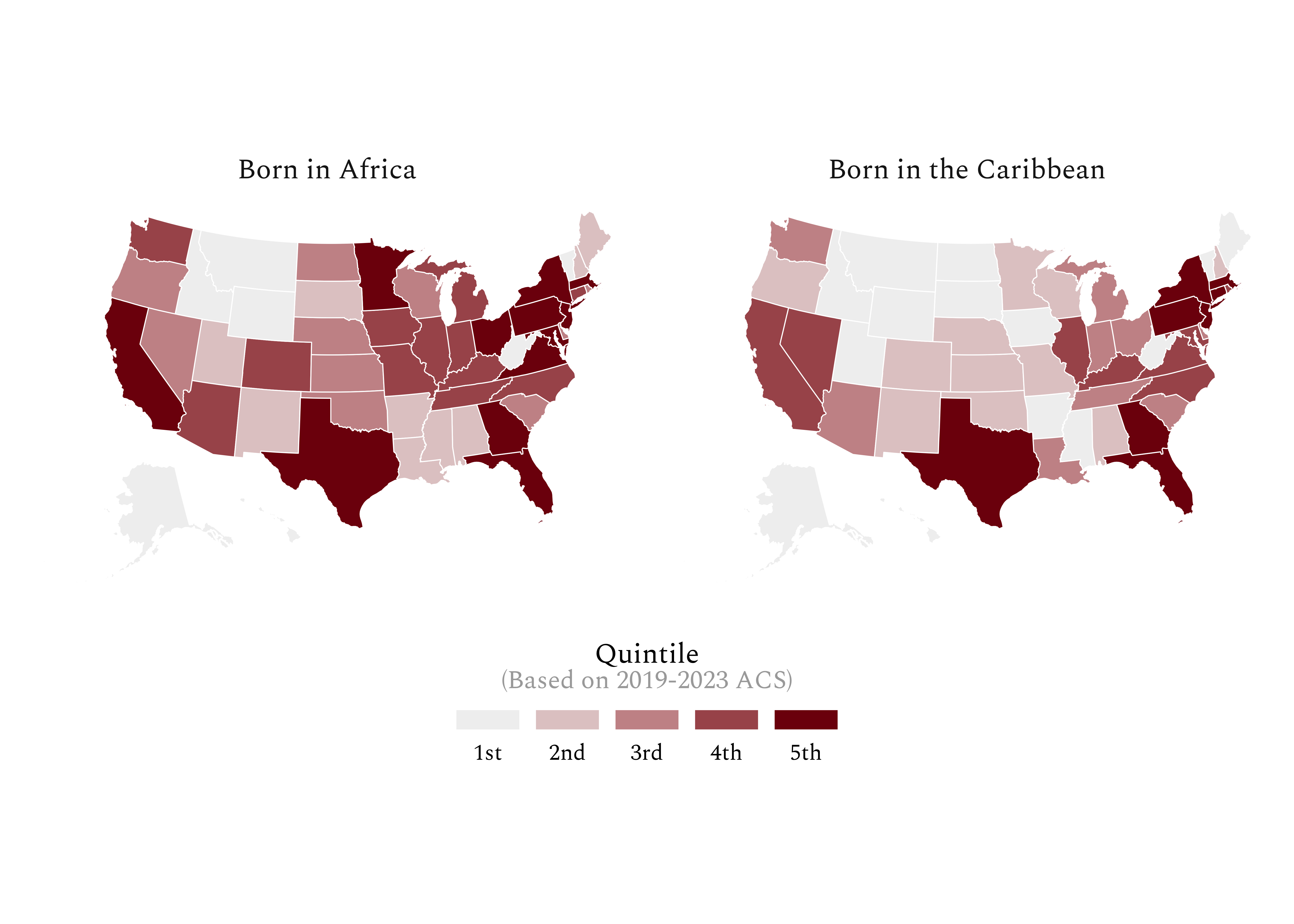
A Growing Subpopulation
The previous map may, of course, be
a tad misleading.
A Growing Subpopulation
Recent Data from the Pew Research Center
A Growing Subpopulation
And yet, the unique experiential trajectories of Black immigrants in America are rarely the focus of research on social integration
(Hamilton 2020).
Why ?
A Growing Subpopulation
[M]uch of the scholarly research on black immigrants has used the outcomes of this group to elucidate the roles of racism and discrimination vis-à-vis poor cultural practices in patterning the outcomes of black Americans.
(Hamilton 2020:296, EMPHASIS ADDED)
Pre-1965 Black Immigration
Early 20th Century
The flow of black immigrants to the United States—primarily from the Caribbean—began in earnest in the 1910s and 1920s. During the first three decades of the twentieth century, the growth of black immigration to the United States outpaced the growth of white immigration as well as native black population growth (Reid 1939). Moreover, during this period, black immigrants were the largest nonwhite racial/ethnic immigrant group in the United States, outnumbering Chinese, Japanese, and Filipino immigrants (Reid 1939).
(Hamilton 2020:297, EMPHASIS ADDED)
Early 20th Century
Black immigration to America began to crater around 1924.
Three Important Factors
Diffuse anti-immigrant sentiment .
Challenges acquiring visas in the Caribbean and Latin America.
Onset of the Great Depression in America and beyond.
Early 20th Century
In the early 20th century, Black migration from beyond the United States coincided with seismic shifts in the spatial distribution of Black Americans within the country.
The Great Migration
While racism and discrimination were prevalent throughout the country, living conditions were considerably harsher in the South than in the northern states. In the face of these bleak conditions, as well as the draw of industrial jobs in the Northeast, more than 1.6 million black Americans moved from the rural South to industrial cities in the Northeast and Midwest between 1916 and 1930, a migration pattern known as the Great Migration.
(Hamilton 2020:298, EMPHASIS ADDED)
The Great Migration
The Great Migration
Amid these transformations, Black internal migrants from the South came into contact with Black international migrants from the Caribbean in places like New York City.
The Great Migration
[D]ata from the complete count files of the US Census show that in 1930 only 27% of blacks living in New York City were born in New York; 61% were born in the United States but outside New York, with most hailing from southern states; and the remaining 12% were foreign born, mainly from the Caribbean.
(Hamilton 2020:298, EMPHASIS ADDED)
Labour Market Disparities?
In the Early 20th Century
Were there significant advantages for foreign-born vis-à-vis native-born Black Americans on the labour market?
Labour Market Disparities?
In the Early 20th Century
Hamilton (2019) found no consistent evidence of significant labor market advantages favoring black Caribbean immigrants during this period. The most robust and consistent disparities documented by Hamilton (2019) were those between whites and all groups of blacks, indicating that any unobserved selectivity and/or cultural differences that existed within New York City’s black population in the early 1900s were not pronounced enough to overcome the enormity of racism during the period.
(Hamilton 2020:298, EMPHASIS ADDED)
A Group Discussion
The Early Black Immigrant Experience
In small groups, discuss whether classical assimilation theory can be used to make sense of the early Black immigrant
experience in America.
The Post-Civil Rights Era
Resurgent Black Migration to America
In 1960, approximately 125,000 black immigrants resided in the United States, nearly all of whom had been born in the Caribbean. By 1980, the number of black immigrants had risen to 816,000, a 553% increase in only two decades.
(Hamilton 2020:300, EMPHASIS ADDED)
Resurgent Black Migration to America
The Black immigrant population grew to more than 1.5 million in the 1980s—due in large part to policy interventions (e.g., Refugee Act of 1980, Immigration Reform and Control Act of 1986).
Resurgent Black Migration to America
While much of the growth of the black immigrant population from the 1960s through the 1980s was driven by Caribbean immigration, African immigration became increasingly important beginning in the mid-1990s, with African immigrants accounting for more than half of the flows of black immigrants to the United States during the 2000s.
(Hamilton 2020:300, EMPHASIS ADDED)
Resurgent Black Migration to America
The shifts in immigration streams that began in the 1990s increased the diversity of the black immigrant population in the United States. Because of the long history of immigration from the Caribbean, since the early 1900s, Jamaica has accounted for the largest flow of black immigrants, followed by Haiti. Indeed, five of the top ten sending countries … of black immigrants are Caribbean countries. The other five are sub-Saharan African countries, highlighting the dramatic growth of the African origin population since 1990.
(Hamilton 2020:300, EMPHASIS ADDED)
Black Immigrants and Racial Disparities
In the Post-Civil Rights Era
Just as earlier immigration waves stimulated the public and academic debates of the early 1900s, the growth of the black immigrant population in the post-1965 era generated robust debate regarding the root causes of disparities between black and white Americans.
(Hamilton 2020:300, EMPHASIS ADDED)
Black Immigrants and Racial Disparities
In the Post-Civil Rights Era
Given the persistent disparities between black and white Americans in the post-1965 era and the long-standing view that the accomplishments of black immigrants are evidence that the poor outcomes of black Americans stem from cultural dysfunction rather than racism and discrimination, it is vital to understand the mechanisms that produce disparities between black Americans and immigrants.
(Hamilton 2020:300, EMPHASIS ADDED)
Three Mechanisms
Some researchers have argued that distinct historical legacies of slavery in the United States and the Caribbean produced cultural differences that in turn led to social and economic disparities between Caribbean immigrants and native-born blacks.
Hamilton (2020:301) EMPHASIS ADDED
Scholars have linked these putative “cultural” cleavages to —
- Institutional variation in the economic organization of slavery in the American South vis-à-vis the Caribbean.
- Compositional differences between the Caribbean—i.e., where slaves constituted a numeric majority—and the American South—where slaves were a numeric minority.
- The psychological benefits accrued to Black immigrants socialized in majority-Black contexts.
Scholars have suggested that labor market disparities between black immigrants and black Americans result from differential patterns of labor market discrimination … Evidence of differential patterns of discrimination comes from black immigrants who report that white employers have a strong preference for black immigrants over black Americans (Foner 1985), black Americans who perceive worse treatment than black immigrants from white employers (Waters 1999), and white managers who state a preference for black immigrants over black Americans.
Hamilton (2020:303) EMPHASIS ADDED
Researchers have also suggested that white employers favor Caribbean immigrants over native-born blacks as a result of the latter group’s connection to the racialized history of slavery in the United States. As a result of this connection, black Americans occupy the least favorable position in the US discrimination hierarchy.
Hamilton (2020:303) EMPHASIS ADDED
[B]lack immigrants, like all other immigrants, are self-selected and thus differ systematically from other individuals in their native countries. Those who emigrate often have better health and higher education levels than their peers who stay in the home county … [I]n 2014, 63% of black Nigerian immigrants residing in the United States had at least a bachelor’s degree, while only 7% of the Nigerian population had earned a bachelor’s degree. In the same year, among immigrants from Haiti … the mean length of schooling was 12.27 years, while among individuals living in Haiti it was 5.18. To varying degrees, this type of selection exists among black immigrants from all major sending countries.
Hamilton (2020:303) EMPHASIS ADDED
Another Group Discussion
Applying Concepts
In new groups, carefully complete the following tasks:
Discuss the relative importance of the three candidate mechanisms detailed in our foregoing discussion.
Draw on Hamilton’s (2020) insights to explain how segmented assimilation theory and neo-assimilationism can be used to understand disparities between native- and foreign-born Black Americans.
Another Group Exercise
Invisible Immigrants?
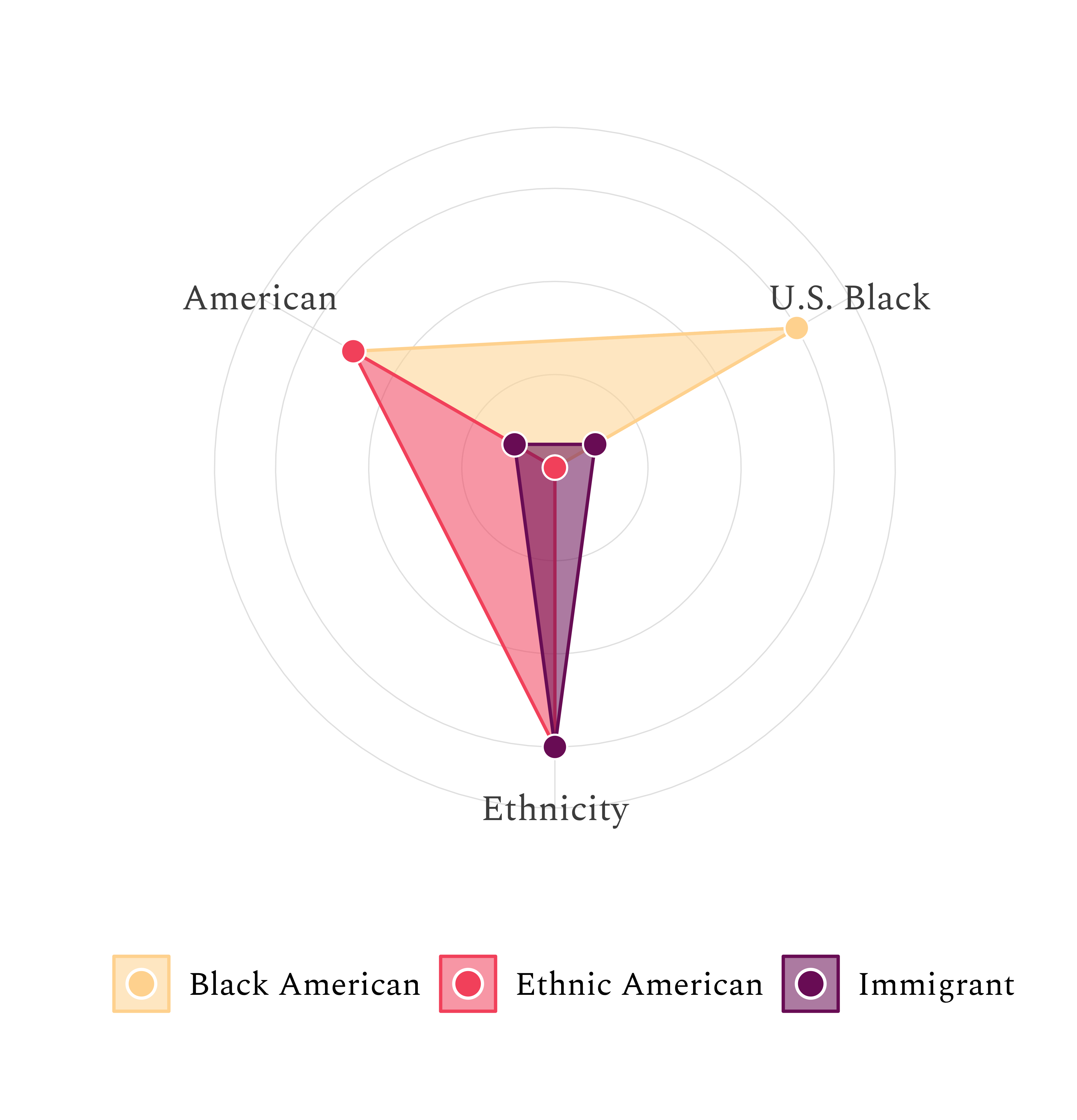
Conceptual Model Stylized Identities Enlarge
Discussion
In an unassigned article, Waters (1994) presents three general kinds of identificational profiles that her interviewees—all Black Americans with immigrant roots—acquired: (i) ethnic-identified; (ii) American-identified; and (iii) immigrant-identified.
- What do you think these general profiles represent?
- How might they be related to the conceptual model on the left?
- What do these profiles tell us about the assimilation of Black immigrants in the United States?
A Final Group Discussion
A Critique of Assimilation Theory
Enjoy the Weekend
References
Note: Scroll to access the entire bibliography